
Custom business applications for the work a spreadsheet can no longer hold.
Castlane builds custom business applications on Microsoft Power Platform: operational systems for growing businesses where spreadsheets have started to limit delivery, visibility or control. Three problems come up most, and each has proof behind it.
Jobs, costing and invoicing · Recruitment and onboarding · Client billing and portals · Pay runs, rotas, approvals, reporting
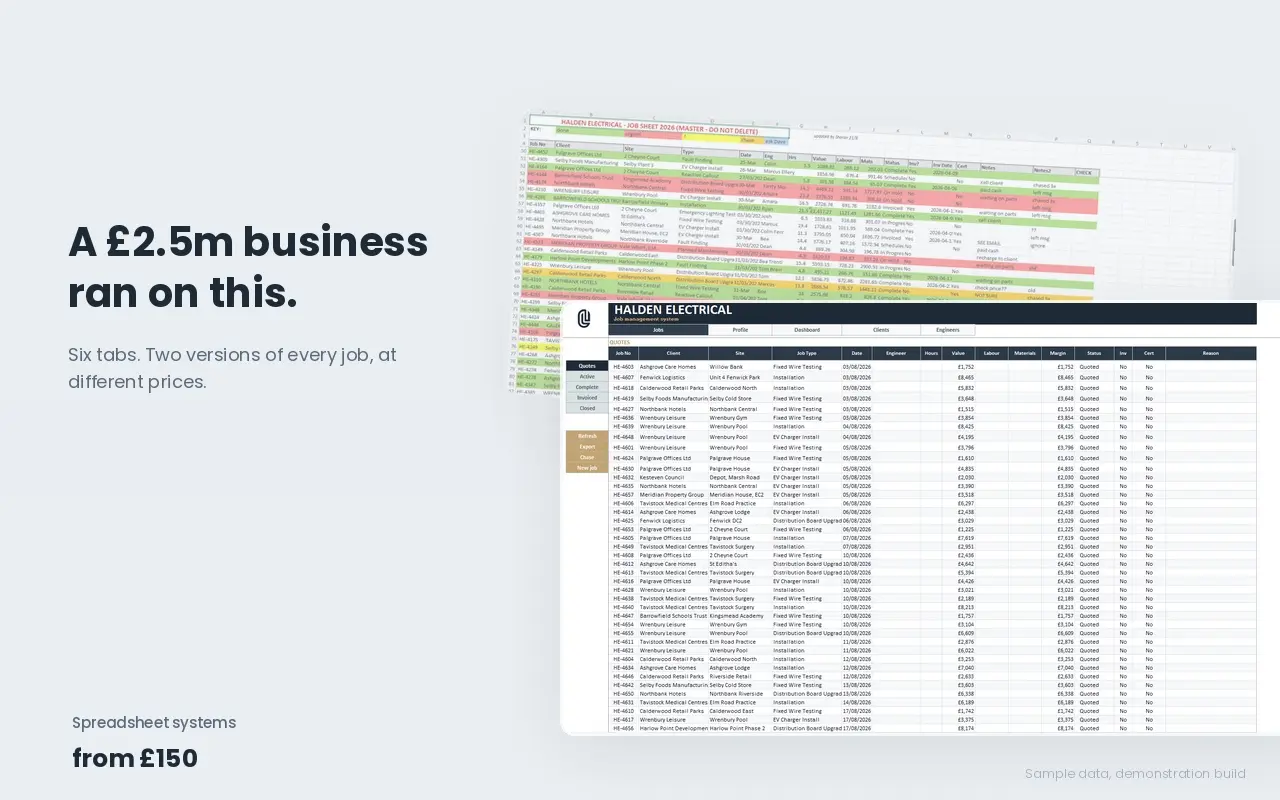
1 · Demonstration build, sample data
Jobs, costing and invoicing
The problem. Jobs live in a tracker. Hours live in another one. Invoicing happens when someone remembers. Nobody can say what a job cost until the accountant works it out months later, and some jobs are never invoiced at all.
What gets built. One record per job with the client, the site, the stage and the people on it. Hours and cost captured per person per job. A quote that becomes a job that becomes an invoice, with the automation chasing what is late and a margin report by client, job type and engineer.
Proof. The Halden Electrical demonstration build: on day one it surfaced 43 completed jobs never invoiced and £132,742 unbilled. See the job system · Power Apps

2 · Anonymised client work
Recruitment and onboarding
The problem. Applicants arrive by email and form. Someone copies them into a sheet. Documents, checks and references are chased by hand, and the people who could start next week are the ones whose paperwork got lost.
What gets built. One record per candidate from first contact to first shift. Stages with the documents each one needs, automated chasing for what is missing, and a view of who is ready to start. The same record becomes the staff record, so nothing is typed twice.
Proof. An application for a London tuition group that took the tutor base from 300 to 1,000, with acquisition up 130% in six months. Track record · Power Automate
300 to 1,000
Tutors onboarded, checked and ready to work, before and after the recruitment application.
Counted from the tutor records in the system, not from registrations. Anonymised; the business is not named.
3 · Anonymised client work
Client billing and portals
The problem. Clients ask what they owe, what they have paid and what is booked, and someone in the office looks it up and emails back. Invoices are built from a sheet that does not quite match the bookings. The month-end takes a week.
What gets built. A CRM that holds the client, the bookings and the charges in one place, an invoicing run that comes from the bookings rather than a re-keyed sheet, and where it earns it, a portal on Power Pages where clients log in to see their balance, their bookings and their invoices.
Proof. The industry’s standard platform for a London tuition group replaced with a Power Apps CRM on Dataverse and a billing-enabled client portal on Power Pages, used by eight staff for several hundred clients and tutors. Track record · Power Platform

Built alongside, or on their own
- Pay runs and payroll reporting. Hours from the system to the pay file without a re-keyed sheet. Flows running daily, weekly and monthly payroll reporting and payment order cycles are part of the anonymised track record.
- Rotas and scheduling. Who is where, with the gaps visible before the day rather than on it.
- Approvals and reminders. Quotes, expenses, holiday, new starters: the request goes to the right person and the answer is recorded.
- Management reporting. Margin, utilisation, debtors and cash, in Power BI from the data the office already enters. This is the part a management accountant builds differently.
A system gets its own page here once a real job gives it a case study. Until then, these are quoted as part of a build or on their own after the call.
